
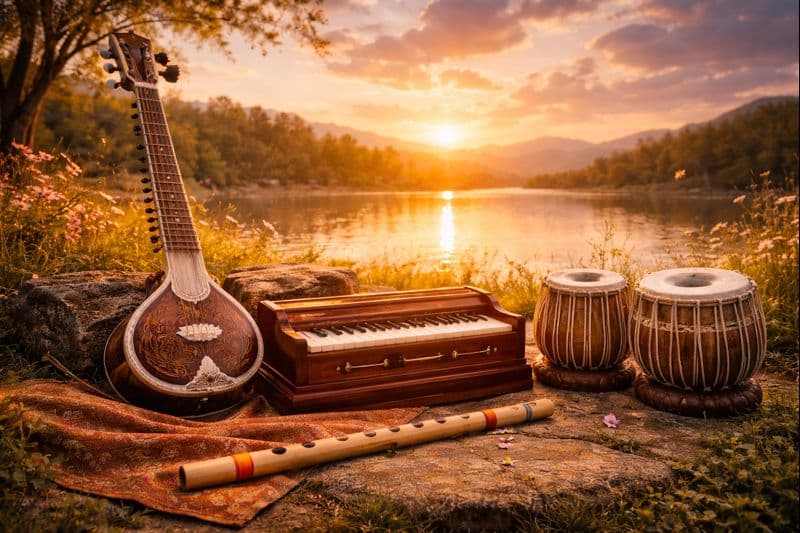
Sastriya Sangeet (Classical Music)
Foundational concepts from Hindustani classical music traditions.
Overview
Sastriya Sangeet refers to classical music traditions that emphasize raga (melodic frameworks) and tala (rhythmic cycles).
Students focus on listening, precision, and gradual mastery of fundamental forms.
Historical & Cultural Context
Hindustani classical music is a major North Indian classical tradition with deep historical roots.
Knowledge is transmitted through lineages and pedagogy that emphasize listening, repetition, and refinement.
Musical Role & Technique
Core study includes raga development, pitch accuracy, and rhythmic discipline within tala cycles.
Exercises often include alap, short compositions, and call-and-response training.
Learning Benefits
Students build attentive listening, nuanced pitch control, and steady rhythmic focus.
The approach supports memory, expressive phrasing, and improvisation skills over time.
Contemporary Use
Hindustani classical music is performed in concerts, festivals, and educational settings.
It also appears in film, devotional contexts, and cross-genre collaborations.
Regional Variations
Performance styles are shaped by gharanas (lineages), which influence phrasing and repertoire choices.
Hindustani and Carnatic are distinct classical traditions with different systems and practices.
Glossary
Raga: a melodic framework that guides pitch selection and melodic movement.
Tala: a repeating rhythmic cycle that structures performance.
Alap: a free-rhythm introduction that explores a raga.
Bandish: a fixed composition used as a basis for performance.
Further Reading
Encyclopaedia Britannica: Hindustani classical music.
ITC Sangeet Research Academy: Hindustani music resources.